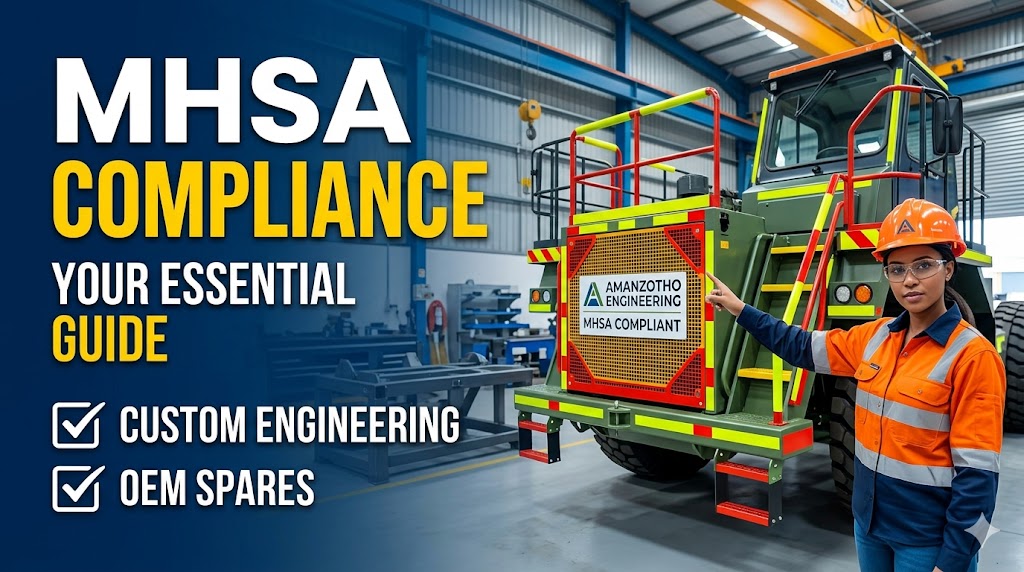
The definitive resource for mine safety managers, maintenance engineers, and procurement leaders who need to align equipment standards with the Mine Health and Safety Act — without compromising production targets.
Who This Guide Is For
🛡️ Compliance Directors
Preparing for DMRE audits, needing legal clarity on equipment requirements and Section 54 risk mitigation.
⚙️ Maintenance Engineers
Seeking custom-engineered solutions for site-specific equipment failures while maintaining OEM warranty integrity.
📊 Procurement Managers
Building the ROI case for OEM spares and custom engineering to justify increased safety spend to the board.
In This Guide
Section 1
Understanding the MHSA: Your Legal Obligations
The Mine Health and Safety Act (Act 29 of 1996) is not advisory — it is the law. Every mine operating in South Africa is legally bound to ensure that all equipment used on-site meets the safety and health standards prescribed by the Act and enforced by the Department of Mineral Resources and Energy (DMRE).
Section 2(1) — General Duties of the Employer
Requires the mine operator to ensure, “as far as reasonably practicable,” a safe working environment. This includes the maintenance, inspection, and replacement of all safety-critical equipment using components that meet or exceed the original manufacturer’s specifications.
Section 11(1) — Equipment Standards
Mandates that every piece of machinery and equipment used at a mine must be properly designed, constructed, and maintained. Using sub-standard replacement parts that compromise structural integrity is a direct violation.
Section 54 — Power to Close Operations
The DMRE inspector can issue a Section 54 stoppage — an immediate halt of all mining operations. A single non-compliant equipment finding can trigger this, costing mines millions of Rands per day.
⚠️ Critical Legal Warning
Under Section 86 of the MHSA, individual managers — not just the mine — can face criminal prosecution for negligence. If a fatality occurs due to non-compliant equipment, the responsible person can face imprisonment. This is personal liability that no insurance policy covers.
“In 22 years of consulting, I have never seen a mine successfully defend a Section 54 stoppage where non-OEM safety-critical parts were found during inspection. The DMRE’s position is clear: if it’s not to specification, it’s not compliant.”
Section 2
The Essential Safety Equipment Checklist
Use this comprehensive checklist to audit your current site. Every item listed below is either explicitly mandated by the MHSA or required to satisfy the “reasonably practicable” standard under Section 2(1).
👷 Personal Protective Equipment (PPE)
- ✅ Hardhat/Safety helmets — SANS 1397 certified, replaced per OEM schedule
- ✅ Self-contained self-rescuers (SCSRs) — Mandatory for underground, inspected monthly
- ✅ Safety boots — Steel-toe, metatarsal protection, SANS 20345 compliant
- ✅ Eye and face protection — SANS 1404, matched to specific hazard type
- ✅ Hearing protection — Mandatory where noise exceeds 85 dB(A)
- ✅ Respiratory protective equipment — SANS 50529, specific to contaminant
- ✅ Fall protection harnesses — EN 361 rated, inspected before each use
🚛 Heavy Mobile Equipment (HME)
- ✅ ROPS/FOPS — OEM-certified to ISO 3471/3449, no field modifications
- ✅ Seat belts and restraints — OEM specification
- ✅ Reverse warning alarms and proximity detection
- ✅ Fire suppression systems — Serviced per OEM intervals
- ✅ Brake systems — OEM parts only, tested per Regulation 18.1
⚙️ Fixed Plant & Conveyor Safety
- ✅ Machine guarding — All rotating parts fully enclosed
- ✅ Conveyor pull-cords — Accessible every 30 metres
- ✅ Lockout/tagout (LOTO) — Standardised across plant
💡 Key Takeaway for Compliance Directors
Print this checklist. Walk your site. Any item that is missing, expired, or has been replaced with non-OEM components is a potential finding in your next DMRE audit — and a potential Section 54 trigger.
Section 3
OEM vs. Aftermarket: The Compliance Risk You Can’t Afford
The temptation to use cheaper, non-OEM “pirate” parts on mining equipment is understandable from a cost perspective. However, the legal, operational, and human cost of this decision is catastrophic.
01 Material Specification Deviations
OEM parts are manufactured to precise metallurgical specifications. Aftermarket components frequently use inferior alloys that fatigue and fracture under mine-site stress conditions.
02 No Traceability or Certification
During a DMRE investigation, inspectors request documentation for every safety-critical component. Aftermarket parts with no certification paper trail create an indefensible compliance gap.
03 Voided Warranties and Transferred Liability
Installing non-OEM components transfers full safety liability from the OEM to the mine operator. In the event of a failure, the mine assumes all legal responsibility.
Section 4
Custom Engineering: When Off-the-Shelf Fails
Standard OEM parts are designed for standard conditions. But no two mines are standard. Your geology, temperatures, and dust loads are unique. This is where custom engineering becomes essential.
When to Use Custom Engineering:
- ✅ OEM parts are discontinued: Reverse-engineering to OEM specification is the only compliant option for older machinery.
- ✅ Site conditions exceed standards: Reinforced guards or modified canopies for extreme environments.
- ✅ Repetitive failures: When standard components fail repeatedly, custom redesign addresses the root cause.
💡 Key Takeaway for Maintenance Engineers
Custom engineering does not void OEM warranties when executed correctly. A Pr.Eng-signed design package with FEA validation and material certificates satisfies the MHSA.
Section 5
The ROI of Compliance-Driven Procurement
Here is the business case for why compliance-driven procurement is the most financially sound strategy available.
Section 6
Building Your Compliance Action Plan
1. Conduct a Full Equipment Audit
Document every piece of safety equipment on site. Flag non-OEM, expired, or undocumented items.
2. Identify Non-Compliant Components
Prioritise replacement by risk level (e.g., brakes, ROPS/FOPS).
3. Document Everything
Maintain a centralised compliance register. When the DMRE inspector arrives, your documentation is your defence.
Don’t Wait for the Audit. Get Compliant Now.
Whether you need OEM spares, custom-engineered safety components, or a full compliance assessment — our team of registered professional engineers is ready to help.
Request a Compliance ConsultationDisclaimer: This article is provided for informational purposes and reflects professional opinion based on industry experience. It does not constitute legal advice. For specific compliance queries, consult directly with a registered professional engineer and your legal team. Article last reviewed: January 2025.