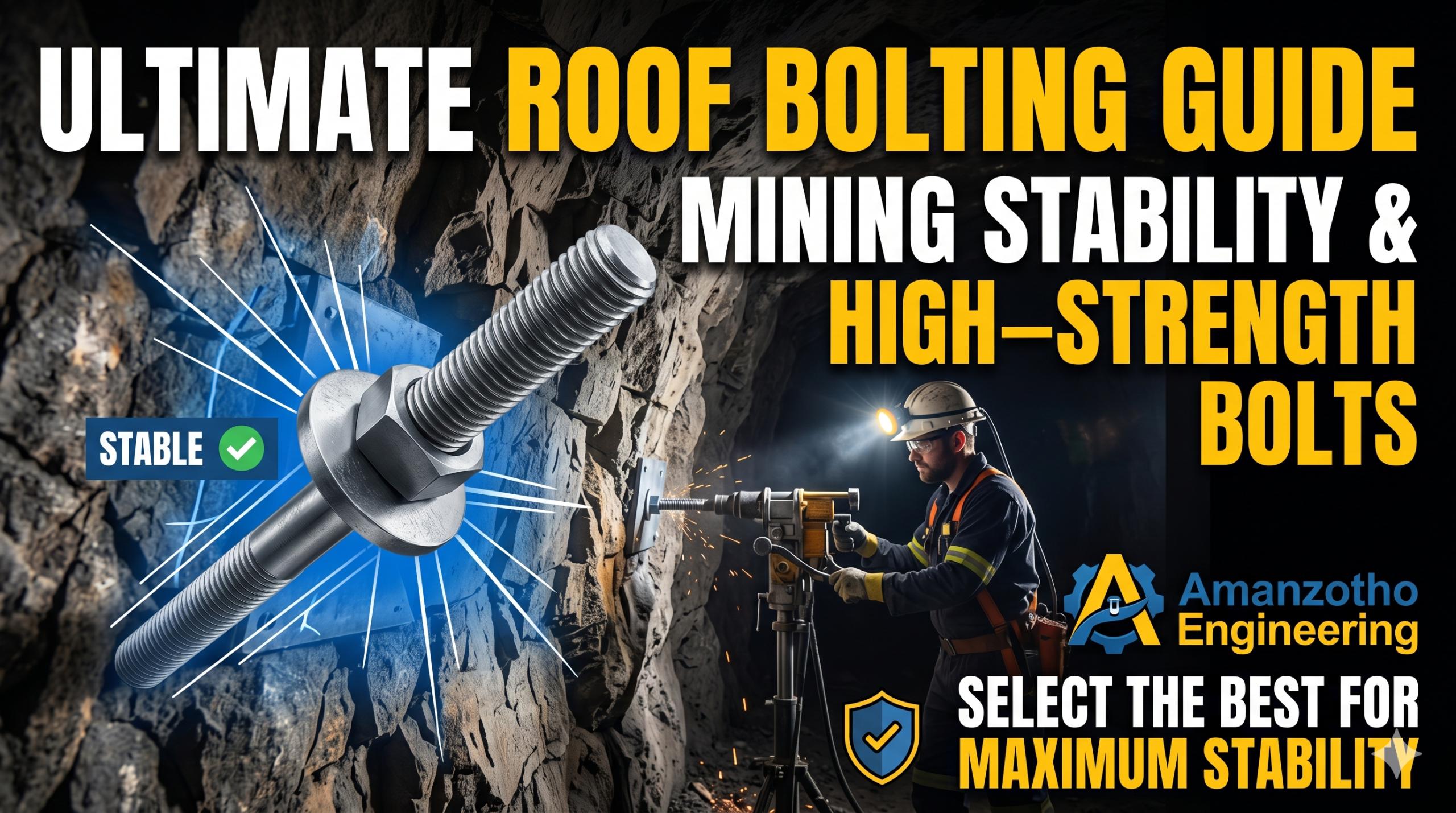
A geotechnical deep-dive into bolt metallurgy, installation efficiency, and supply chain reliability for underground mining operations.
Key Takeaways
- High-strength bolts (Grade 60+) reduce bolt density by up to 30%, cutting installation time and improving cycle efficiency.
- Resin-grouted bolts outperform mechanical anchors in weak, laminated strata—delivering 2.3× higher pull-out resistance in coal measure rocks.
- Corrosion-resistant coatings (hot-dip galvanized or epoxy) extend bolt service life by 15–25 years in acidic groundwater conditions.
- Proper supplier vetting (ISO 9001, mill test certificates, JIT logistics) prevents costly operational shutdowns from supply gaps.
1. Why Roof Bolt Selection Is a Life-or-Death Engineering Decision
Underground mining is an inherently adversarial environment. The overlying rock mass, fractured by millions of years of tectonic stress and further destabilized by the excavation process itself, is constantly working to reclaim the void you’ve created. Roof bolts are the primary line of defense between a productive mine and a catastrophic ground failure event.
According to MSHA (Mine Safety and Health Administration) data, ground falls remain the leading cause of fatalities in underground mining, accounting for approximately 30% of all underground mining deaths over the past decade. The selection of roof bolts isn’t a procurement checkbox—it’s a geotechnical engineering decision with direct life-safety consequences.
🛡️ For Mine Managers & HSE Officers
If your operation is transitioning to deeper seams or encountering unfamiliar geology, this section outlines why a bolt audit should be your first action item—not your last.
The consequences of incorrect bolt specification cascade through every level of an operation: worker safety, regulatory compliance, production continuity, and long-term mine viability. A bolt that performs adequately at 200m depth may fail catastrophically at 400m, where vertical stress can double and the rock mass behavior fundamentally changes from elastic to plastic deformation.
2. Types of High-Strength Roof Bolts: A Comparative Analysis
Not all roof bolts are created equal. The three primary categories—resin-grouted rebar bolts, mechanical expansion anchors, and friction rock stabilizers (Split Sets / Swellex)—each have distinct mechanical properties, installation profiles, and geological suitability. Understanding these differences is the foundation of effective ground support design.
🔬 For Geotechnical Engineers
The following comparison focuses on ASTM F432-compliant bolts. If you’re working with non-standard specifications (e.g., Australian AS/NZS 4792), the yield/tensile values will differ. Contact our engineering team for region-specific data sheets.
Resin-Grouted Rebar Bolts
BEST FOR: Laminated / Weak StrataResin-grouted bolts create a full-column bond between the bolt and the rock, distributing load along the entire bolt length. This makes them the preferred choice in coal measure rocks, shale, and laminated strata where point loads from mechanical anchors could cause localized failure.
Mechanical Expansion Anchors
BEST FOR: Hard Rock / Competent StrataMechanical anchors grip the rock at a single point (the anchor shell) and rely on torque-induced tension. They offer rapid installation (no resin mixing time) and immediate load-bearing capacity, making them ideal for hard, competent rock such as granite, basalt, or massive sandstone.
Friction Rock Stabilizers (Split Sets)
BEST FOR: Temporary Support / DevelopmentFriction bolts rely on radial friction against the borehole wall. They offer the fastest installation of any bolt type but carry lower load capacities. Best suited as temporary or supplementary support in mine development headings.
3. Technical Specifications: The Numbers That Matter
When specifying roof bolts for a ground support plan, five mechanical properties determine whether a bolt will maintain roof integrity or fail under operational stress. The table below provides a side-by-side comparison across all three bolt categories.
| Property | Resin-Grouted (Gr.75) | Mechanical Anchor | Split Set (SS46) |
|---|---|---|---|
| Yield Strength | 75 ksi (517 MPa) | 60 ksi (414 MPa) | N/A (friction) |
| Ultimate Tensile | 100 ksi (689 MPa) | 80 ksi (552 MPa) | 55 ksi (379 MPa) |
| Elongation (8″) | ≥ 14% | ≥ 14% | ≥ 8% |
| Shear Resistance | 22–28 tons | 14–18 tons | 4–7 tons |
| Pull-Out (coal strata) | 18–24 tons | 8–14 tons | 3–5 tons |
| Corrosion Resistance | High (encapsulated) | Medium | Low |
| Install Time / Bolt | 60–90 sec | 30–45 sec | 15–20 sec |
| Cost per Bolt (approx.) | $8–15 + resin | $5–10 | $4–8 |
🔬 Engineering Note
All values above are for #6 rebar (19mm / ¾”) diameter bolts at standard lengths (1.2–2.4m). For #7 and #8 rebar (22mm and 25mm), multiply load values by approximately 1.35× and 1.78× respectively. Always verify against manufacturer mill test certificates.
4. Geology-Specific Bolt Selection: Matching Bolt to Rock
The single most critical factor in bolt selection is the geological environment. A bolt system that performs flawlessly in massive sandstone can fail entirely in thinly laminated shale. Here’s how to match bolt type to geology:
Coal Measure Rocks (Shale, Mudstone, Siltstone)
Recommended: Resin-grouted rebar (Grade 60–75)
These laminated, moisture-sensitive strata are prone to delamination and swelling. Full-column resin encapsulation provides distributed load transfer across weak bedding planes. Mechanical anchors are generally not recommended—the anchor shell can punch through individual laminae, resulting in anchor slip.
Key design consideration: Use slow-set resin at the top of the hole and fast-set at the bottom for optimal spin-to-hold timing.
Hard Rock (Granite, Basalt, Quartzite)
Recommended: Mechanical expansion anchors or resin point-anchor
Competent, massive rock provides excellent anchorage for point-load systems. Mechanical bolts are highly effective here, with installation times 50% faster than resin systems. At depths exceeding 1,000m, consider upgrading to Grade 75 resin-grouted bolts to manage elevated horizontal stress.
Corrosive / High-Groundwater Environments
Recommended: Resin-grouted with hot-dip galvanized or epoxy-coated rebar
Acidic groundwater (pH < 5.5) can reduce uncoated bolt cross-section by 0.5–1.0mm per year. Over a 15-year mine life, that’s a potential 40–60% reduction in load-bearing capacity. Galvanized coatings (ASTM A767) or dual-layer epoxy systems are essential in these conditions.
5. Installation Efficiency & Safety Standards
🛡️ For Mine Managers & HSE Officers
This section directly addresses how bolt selection impacts your production cycle time and TRIFR (Total Recordable Injury Frequency Rate). Upgrading to high-strength bolts can create a measurable improvement in both metrics.
The relationship between bolt strength and installation density is inversely proportional: higher-strength bolts allow wider bolt spacing, which directly reduces the number of holes drilled per metre of advance. This has cascading benefits:
Bolt Density Reduction: Grade 40 vs. Grade 75
Before: Grade 40 System
- • Bolt spacing: 1.0m × 1.0m
- • Bolts per 5m wide heading: 25 bolts/row
- • Install time per row: ~38 minutes
- • Drill consumables cost: High
After: Grade 75 System
- • Bolt spacing: 1.2m × 1.5m
- • Bolts per 5m wide heading: 14 bolts/row
- • Install time per row: ~21 minutes
- • Drill consumables cost: 44% lower
* Spacing values are illustrative. Actual bolt patterns must be determined by geotechnical analysis per ASTM D4435 and local regulatory requirements.
Compliance & Regulatory Standards
All roof bolt installations must comply with the relevant jurisdictional standards. Key references include:
6. Supply Chain & Procurement: De-Risking Your Bolt Supply
📦 For Procurement & Supply Chain Directors
This section addresses the #1 procurement risk in underground mining consumables: supply continuity. A mine cannot legally or safely advance without certified ground support. Here’s how to evaluate suppliers beyond price-per-bolt.
Supply chain failure in roof bolt procurement isn’t a delayed shipment—it’s a complete operational shutdown. When bolts don’t arrive on site, mining stops. Period. For a mine producing $500,000/day in ore, a single week of bolt-related downtime represents $3.5 million in lost revenue.
Supplier Evaluation Framework
Quality Certifications
ISO 9001:2015 (Quality Management), ISO 14001 (Environmental), and third-party mill test certificates for every heat of steel. Ask for certificates—don’t accept self-declarations.
Manufacturing Capacity & Redundancy
Does the supplier operate multiple manufacturing facilities? A single-plant supplier is a single point of failure. Look for annual output capacity of 50M+ bolts across distributed locations.
JIT Logistics & Regional Warehousing
Can the supplier deliver to your mine site within 48–72 hours? Look for regional distribution centers, consignment stocking programs, and dedicated logistics partnerships.
Technical Support & Custom Engineering
Does the supplier have in-house geotechnical engineers who can assist with bolt selection, pull-testing, and site-specific recommendations? This differentiates a true partner from a commodity vendor.
7. Cost-Benefit Analysis: The Economics of High-Strength
High-strength bolts carry a 30–50% price premium per unit over standard Grade 40 bolts. However, when you factor in reduced bolt density, faster installation, and lower failure rates, the total cost of ownership is typically 15–25% lower. Here’s the math:
Cost Model: 1,000m of Tunnel Advance
| Cost Component | Grade 40 System | Grade 75 System | Savings |
|---|---|---|---|
| Bolt material cost | $125,000 | $108,000 | $17,000 |
| Drill consumables | $62,000 | $35,000 | $27,000 |
| Labour (installation) | $210,000 | $130,000 | $80,000 |
| Downtime (remediation) | $95,000 | $18,000 | $77,000 |
| Total | $492,000 | $291,000 | $201,000 (41%) |
* Model assumes a 5m×4m heading cross-section in coal measure rock. Labour costs based on US underground mining rates (2024). Downtime costs calculated at $15,000/hour.
8. Case Studies: Real-World Performance Data
Transition from Grade 40 to Grade 75 Resin Bolts at 350m Depth
A longwall coal operation experiencing increasing convergence rates at depth transitioned their ground support from Grade 40 (1.2m × 1.2m pattern) to Grade 75 resin-grouted bolts (1.5m × 1.5m pattern). Results over 12 months:
Corrosion Mitigation in Acidic Groundwater (pH 4.2)
A hard-rock gold mine experiencing premature bolt failure due to acidic groundwater switched from uncoated mechanical bolts to epoxy-coated, resin-grouted Grade 75 bolts. After 3 years:
9. Conclusion & Next Steps
Roof bolt selection is not a commoditized decision. The geology, depth, groundwater chemistry, and production requirements of each mine create a unique engineering problem that demands a tailored ground support solution. High-strength bolts—particularly Grade 75 resin-grouted systems—offer a demonstrably superior combination of safety factor, installation efficiency, and total cost of ownership across the majority of underground mining applications.
Whether you’re a geotechnical engineer specifying bolt metallurgy, a mine manager optimizing your production cycle, or a procurement director vetting enterprise suppliers—the data is clear: investing in higher-strength ground support pays for itself.