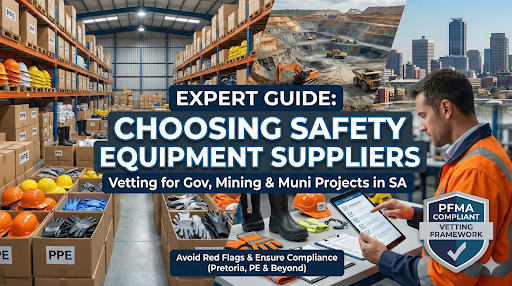
This article is written by a procurement professional with direct experience evaluating safety equipment suppliers for government contracts, mining operations, and municipal infrastructure projects across South Africa. The insights reflect real-world vendor management challenges and proven vetting methodologies aligned with PFMA compliance requirements.
1. Introduction: Why Supplier Choice Matters More Than You Think
As a procurement manager or supply chain director, you’ve been there: You win a tender for a R20 million infrastructure project. The budget is approved, the community is waiting, and your KPI depends on completion. Then, halfway through the project, your safety equipment supplier runs out of capital. Suddenly, your workers don’t have proper PPE, your site is at risk, and your entire timeline is compromised.
This isn’t a hypothetical scenario. It happens. And it costs careers.
The Reality: Choosing the wrong safety equipment vendor can derail projects, trigger audit failures, expose your organization to liability, and damage your professional reputation. The right vendor becomes a strategic partner who ensures on-time delivery, regulatory compliance, and peace of mind.
This guide is designed for decision-makers like you—whether you’re a Supply Chain Manager at a municipality, a Technical Director at a mining house, or a Chief Engineer responsible for site safety across South Africa. We’ll walk through a proven framework for evaluating safety equipment vendors in Pretoria, Port Elizabeth, Mpumalanga, and beyond, with specific focus on compliance, capacity, and reliability.
2. What Procurement Managers Actually Need From a Safety Equipment Supplier
Before diving into the vetting process, let’s be clear about what you’re actually looking for. This isn’t about finding the cheapest option—that’s how you end up with a ghost supplier.
The Five Core Requirements
Verified Legitimacy:Is this a real company with physical operations, proven track record, and regulatory compliance—or just someone with a business card?
Financial Stability:Can they sustain operations throughout your contract period without running out of cash or hitting crisis points?
Local Capacity:Do they have warehouse stock and logistics in your region so you can get PPE within 24-48 hours, not weeks?
Compliance Mastery:Are they PFMA-aware, B-BBEE certified, CIDB registered, and tax-compliant? Can they navigate government procurement without stumbling?
Responsive Partnership:When there’s an emergency on site at 6am, will they answer the phone and solve the problem—or will you get sent to voicemail?
These aren’t luxuries. They’re non-negotiables for any organization handling public or private sector contracts.
3. Common Pain Points: Why Procurement Managers Lose Sleep Over PPE Vendors
Pain Point #1: The Incomplete Tender Submission
You receive bids from vendors who forget tax clearance certificates, B-BBEE affidavits, or CIDB registration documents. Your evaluation team wastes hours sending follow-up emails, and half the submissions still come back incomplete. Meanwhile, evaluation timelines slip.
Why it matters: Under PFMA compliance, incomplete bids can be grounds for disqualification—even if the vendor is otherwise perfect. And incomplete submissions indicate organizational sloppiness that will show up again during contract execution.
Pain Point #2: Mid-Project Cash Flow Crisis
You award the contract to the lowest bidder. For three months, everything looks fine. Then, suddenly, your vendor stops responding to calls. When you finally track them down, you learn they’ve run out of capital and can’t fulfill their obligations. Now you’re stuck with 200 workers who need safety equipment and no supplier.
Why it matters: Project stoppages create cascading costs—idle workers, community complaints, missed deadlines, and audit scrutiny. And you’re left scrambling for emergency procurement at inflated prices.
Pain Point #3: The Ghost Vendor
Their website looked professional. Their pitch was polished. But when you visit their “warehouse address” before signing, it’s a residential house. No fleet, no inventory system, no staff. Just someone with a laptop and dreams of your contract.
Why it matters: This is a tender fraud risk. If you award a contract to someone without verifiable physical capacity, you’re exposed to audit failure and reputational damage. And you still need to find another supplier—now with compressed timelines.
4. The 5-Step Vendor Vetting Framework for Safety Equipment Suppliers
This framework is designed for use during bid evaluation and prior to contract award. It’s systematic, documentable, and aligned with PFMA compliance requirements.
Step 1: Verify Legal Compliance (Non-Negotiable)
Before anything else, confirm the vendor meets basic regulatory requirements. If they can’t demonstrate compliance, stop evaluation immediately.
Valid SARS Tax Clearance Certificate (TCC)—confirm it’s current and matches the company registration name
B-BBEE Certificate or B-BBEE Affidavit—verify the level and confirm the issuing body
CIDB Registration—confirm the appropriate grading for your contract scale
CIPC Company Registration Documents—verify ownership structure and directorship
Proof of Active Bank Account—request a bank letter confirming account good standing
Pro Tip: Don’t just accept photocopies. Verify directly with SARS, the B-BBEE issuing body, and CIDB. It takes 15 minutes and catches 80% of fraud attempts.
Step 2: Assess Physical Capacity (Visit, Don’t Just Ask)
The best way to avoid ghost vendors is to visit their operations. Schedule a site inspection of their warehouse, office, and facilities. This isn’t optional for contracts above R5 million.
Verify the physical address matches their business registration
Inspect warehouse conditions, storage capacity, and inventory management systems
Photograph their fleet (trucks, vans, equipment) to verify logistics capability
Meet the operations manager and key staff—assess their competence and responsiveness
Request current inventory list for relevant safety equipment categories
Confirm delivery routes and timelines for your region
What You’re Looking For: Professional operations, organized inventory systems, adequate staff, and realistic assessment of their capacity to handle your order volume. If the warehouse is chaotic or the team seems disorganized, that’s a red flag.
Step 3: Evaluate Financial Stability (Look at the Numbers)
A vendor with inadequate cash flow will fail mid-contract. Request their audited financial statements for the past 2-3 years and have your finance team review them.
Audited annual financial statements (past 2-3 years)
Bank letter confirming account in good standing with typical turnover
Credit reference from suppliers (ask for 2-3 vendor references)
Proof of previous contract completion at similar scale and budget
Trade references from at least 3 existing clients
Key Indicators of Instability: Declining revenue year-over-year, increasing debt ratios, poor payment history with suppliers, or vague financial statements. If a vendor won’t provide audited financials, that’s a major warning sign.
Step 4: Confirm Product Quality & Certification (Safety First)
Safety equipment must meet South African and international standards. There are no shortcuts here.
SABS certification for all locally-manufactured safety equipment
CE marking for imported equipment (European standard)
ISO 9001 certification for the supplier’s quality management system
Product warranties and after-sales support details
Availability of sample products for inspection before bulk order
Traceability systems for product batches and serial numbers
Pro Tip: Don’t assume certification. Request documentation for each product category. Ask them to provide a SABS certificate for specific items you’ll be ordering. If they hesitate, move on.
Step 5: Test Responsiveness Before Commitment (The Trial Run)
Before signing a major contract, test how the vendor handles urgent requests. Send a complex enquiry, ask for a custom quote, request a sample delivery. See how they respond.
Response time to initial enquiry—target: 24 hours
Willingness to customize solutions for your specific needs
Clarity of communication—are quotes detailed and professional?
Emergency contact availability—can you reach decision-makers after hours?
Problem-solving approach—when you raise a concern, do they take it seriously?
This responsiveness test is your early warning system. A vendor who’s slow or dismissive during the sales phase will be impossible during contract execution.
5. Regional Safety Equipment Supplier Guide: Pretoria, Port Elizabeth & Beyond
South Africa’s regional differences matter. A vendor who works well in Gauteng might struggle in Port Elizabeth or Mpumalanga. Here’s what to look for in different regions.
Safety Equipment Suppliers Pretoria: Government & Municipal Focus
Pretoria is the administrative hub—municipalities, government departments, and SOEs cluster here. Vendors servicing Pretoria need deep PFMA knowledge and experience navigating bureaucratic procurement.
What to Verify:
- Previous contracts with Tshwane, City of Johannesburg, or provincial government departments
- Understanding of bid evaluation processes and tender compliance requirements
- Warehouse within Gauteng for 24-48 hour delivery to Pretoria sites
- Experience handling bulk orders (municipal fleet safety equipment, construction PPE)
- Documentation of past contract value and completion rates
Key Challenge: Government projects are high-scrutiny. Your vendor needs to be comfortable with audits, committee meetings, and compliance inspections. If they’re defensive about documentation, they’re not ready for government work.
Safety Equipment Port Elizabeth: Manufacturing & Automotive Hub
Port Elizabeth’s economy is driven by automotive manufacturing and heavy industry. Vendors here need to understand industrial PPE requirements and shift-based operations.
What to Verify:
- Experience supplying manufacturing plants and automotive facilities
- Understanding of mining-grade and industrial PPE standards
- Coastal logistics capability and experience serving Eastern Cape projects
- Ability to handle rapid reordering and just-in-time delivery
- Track record with 24/7 operations and shift changes
Key Challenge: Industrial clients expect reliability and speed. Your vendor needs demonstrable experience with manufacturing operations and rapid turnaround capability.
Mpumalanga & Limpopo: Mining & Infrastructure Belt
This region includes major mining operations (Secunda, Witbank) and ongoing infrastructure projects. Vendors here must understand underground safety requirements and rural logistics challenges.
What to Verify:
- Direct experience with mining operations and underground safety protocols
- Understanding of ICMM and local mining company standards
- Capacity to deliver to remote sites and manage logistics across difficult terrain
- Experience with government infrastructure contracts (roads, water, energy)
- Local relationships and community knowledge
Key Challenge: This region requires vendors with deep local knowledge. Ghost suppliers and Johannesburg-based vendors often underestimate rural logistics challenges. Prioritize vendors with local operations.
Why Local Stock Availability Matters: When an emergency happens on your Mpumalanga site at 5am—a burst pipe, a safety violation, a worker injury—you can’t wait 3 weeks for PPE to arrive from overseas. A vendor with local warehouse stock can have replacement equipment on site within 24 hours. This isn’t convenience; it’s the difference between project continuation and costly downtime.
6. Red Flags: Warning Signs That Should Disqualify a Vendor
After years managing procurement, these warning signs reliably indicate a vendor who will cause problems. Trust your instincts when you spot them.
⚠ Red Flag #1: No Physical Address or Unwilling to Host Site Visits
If a vendor refuses to let you visit their operations or their address is a residential house, they’re not legitimate. Real companies have professional facilities and invite client visits.
⚠ Red Flag #2: Prices Significantly Below Market Rate
If their quote is 30-40% lower than competitors, they’re either cutting corners on quality or planning to fail mid-contract. Realistic margins exist for a reason.
⚠ Red Flag #3: Cannot Provide References From Similar-Sized Contracts
If they’ve never handled a contract at your scale, they’re an unknown risk. Require references from projects of similar budget and complexity.
⚠ Red Flag #4: Expired or Missing Compliance Certificates
Under PFMA, this is grounds for immediate disqualification. If their tax clearance or B-BBEE certificate is expired, they’re not serious about compliance.
⚠ Red Flag #5: No Product Samples Available for Inspection
Real suppliers have sample inventory. If they can’t provide samples for quality inspection, they might not have stock at all.
⚠ Red Flag #6: Slow Response to Urgent Queries (>48 hours)
If they’re slow during the sales phase, they’ll be impossible during contract execution. Responsiveness is non-negotiable.
⚠ Red Flag #7: Vague Delivery Timelines or “Subject to Availability” Clauses
Competent vendors commit to specific timelines. Vague delivery commitments indicate they don’t have stock or capacity.
7. Quality Standards & Compliance Verification: Don’t Compromise on Safety
Safety equipment isn’t a commodity. Quality directly impacts worker safety and legal liability. Here’s how to verify genuine compliance.
South African Standards (SABS)
For locally-manufactured safety equipment, SABS certification is mandatory. Examples include:
- SANS 1011: Safety helmets (hard hats)
- SANS 1012: Hand and wrist protection gloves
- SANS 1014: Industrial protective footwear
- SANS 1010: Eye and face protection
- SANS 1015: Respiratory protective devices
How to Verify: Request the specific SABS certificate for each product you’ll order. Check the issuing date and validity period. Contact SABS directly if you need confirmation.
International Standards (CE Marking)
For imported equipment (common for specialized PPE), CE marking indicates compliance with European standards. However, CE marking alone is not sufficient in South Africa—SABS certification takes precedence for locally-sold goods.
ISO 9001 Quality Management
Suppliers should have ISO 9001 certification, demonstrating they have quality management systems in place. This indicates they track product batches, manage complaints, and maintain consistent standards.
Mining-Specific Standards (If Applicable)
For mining operations, additional standards apply:
- ICMM Standards: International Council on Mining and Metals guidelines
- DMR Requirements: Department of Mineral Resources specifications
- Company-Specific Standards: Major mining houses (Glencore, Anglo) often have proprietary PPE standards
Confirm your vendor understands these sector-specific requirements before awarding a mining contract.
8. Real-World Case Study: What Success Looks Like
Let’s walk through a real scenario: A municipality in Limpopo needs to procure safety equipment for a 18-month road upgrade project (R8 million budget). Here’s how proper vetting played out.
The Challenge
The municipality received five bids. Three were immediately disqualified due to expired tax clearance certificates. Of the remaining two, one bid was 35% below market rate (red flag), and the other was from a vendor with established references.
The Vetting Process
The procurement team visited the “serious” vendor’s operations in Mpumalanga:
- Verified their warehouse was professional, well-organized, and stocked with current inventory
- Met their operations manager—competent and responsive
- Reviewed their financials—5 years of consistent profitability
- Called their three trade references—all spoke positively about on-time delivery and quality
- Requested SABS certificates for all product lines—provided immediately with originals
The Outcome
The municipality awarded the contract to the compliant vendor. Results after 18 months:
- 100% on-time delivery across 12 monthly shipments
- Zero quality complaints or product failures
- Emergency request during project (burst pipe, urgent PPE replacement)—delivered within 6 hours
- Project completed on schedule and budget
- Vendor awarded follow-on contract based on performance
The Lesson: Proper vetting takes time upfront but saves exponential time and cost during execution. The “cheap” vendor who was disqualified might have cost the municipality R2-3 million in project delays. The compliant vendor ended up being the most cost-effective choice when you factor in reliability and performance.
9. FAQ: Critical Questions to Ask Your Safety Equipment Vendor
| Question to Ask | Why It Matters |
| How long has your company been operating? | Vendors operating less than 3 years are higher risk. 5+ years demonstrates sustainability. |
| Can you provide references from government/municipal contracts? | This proves they understand public sector procurement and PFMA requirements. |
| What is your typical delivery timeframe for bulk orders? | Reliable vendors commit to specific timelines. Vague answers indicate capacity issues. |
| Do you maintain local warehouse stock or drop-ship from overseas? | Local stock means 24-48 hour delivery. Drop-shipping means weeks of wait time. |
| What happens if we need emergency delivery outside normal hours? | Real partners have contingency plans and escalation procedures for emergencies. |
| Can you provide SABS or CE certificates for each product category? | Non-negotiable. If they can’t, they’re not selling certified equipment. |
| How do you handle product complaints or quality issues? | Their response process indicates whether they take safety seriously. |
| What is your payment terms flexibility for government contracts? | Government often pays 30-60 days after invoice. Vendors must be able to sustain this. |
| Do you have experience with mining operations or sector-specific standards? | If your project is mining-focused, sector experience is critical. |
| Can we visit your operations before signing the contract? | Any vendor who refuses is likely not legitimate or hiding something. |
10. Conclusion: Making the Right Choice
Choosing the right safety equipment supplier isn’t just about finding the lowest price. It’s about risk management, compliance assurance, and strategic partnership.
The framework outlined in this guide—verifying compliance, assessing capacity, evaluating financial stability, confirming quality, and testing responsiveness—takes discipline and time. But it works. It prevents ghost vendors, avoids mid-project crises, and ensures your projects complete on schedule and on budget.
“A procurement manager’s job isn’t to win the bid cheapest. It’s to deliver the project on time, within budget, and with no surprises. The right supplier partner makes that possible. The wrong one makes it impossible.”
Your Next Steps
- Document Your Requirements: Define exactly what safety equipment you need, volumes, timelines, and regional coverage.
- Apply the 5-Step Vetting Framework: Use it during bid evaluation for every vendor above R1 million contract value.
- Schedule Site Visits: For shortlisted vendors, visit their operations personally. Don’t skip this step.
- Verify Compliance Directly: Check tax clearance, B-BBEE status, and CIDB registration with the actual bodies—not just photocopies.
- Request References and Call Them: Ask detailed questions about delivery reliability, quality, and responsiveness.
- Test Responsiveness: Send a complex enquiry during the sales phase. See how they respond.
- Award Based on Capacity, Not Just Price: Choose the vendor who can actually deliver—not the cheapest option.
Remember: The cheapest bid often costs the most in the end. The compliant, responsive, financially stable vendor is the one who ensures your projects succeed.